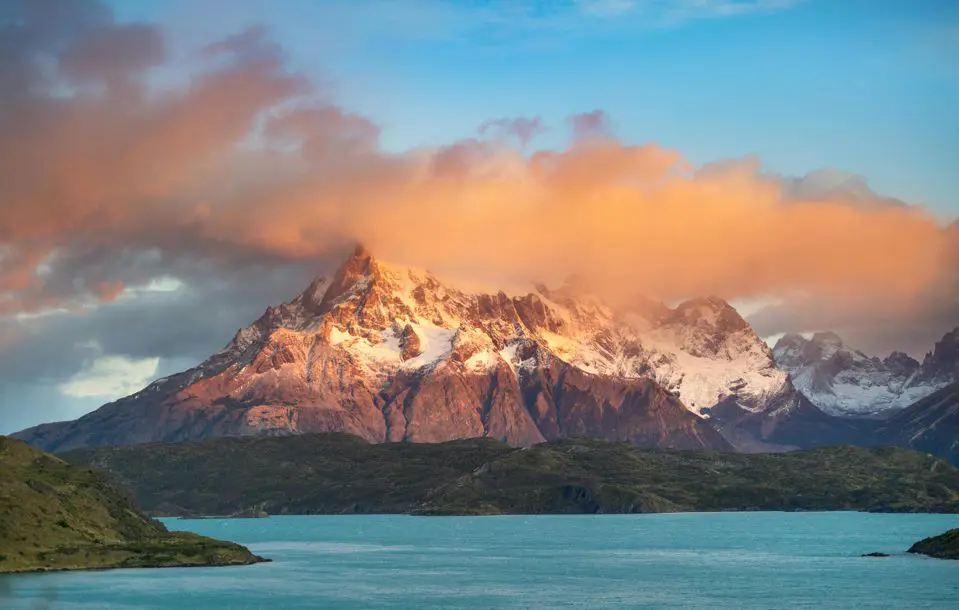
Torres del Paine National Park, in Chilean Patagonia, is a paradise for hiking and a challenge for the traveler. Facing mountains, glaciers, steppe, turquoise lakes, and wild animals, an inevitable decision arises: do the W Circuit or the O Circuit in Torres del Paine? Both are legendary trails running through the heart of this destination, one of the most striking sites on the planet, but each proposes a different rhythm, level of demand, and perspective on the same landscape.
Torres del Paine National Park, declared a Biosphere Reserve by UNESCO, extends in the extreme south of Chile, in the Magallanes Region. With nearly 230,000 hectares, it is a setting demanding time and preparation to explore. Here the wind rules, and the weather can change several times in a single day. However, those daring to tour this park on foot do not just walk a territory: they immerse themselves in an experience transforming the perception of the body and time.
The park's two great trekking circuits of Torres del Paine, known as "W" and "O" for the shape they draw on the map, are mythical routes among travelers worldwide. In recent years they have become cult destinations for experienced hikers and adventurers seeking to exceed their limits in one of the planet's most remote and changing landscapes.
The Essentials to Know About Torres del Paine National Park
Before entering the trails, every traveler goes through the same sensation: that mix of vertigo and enthusiasm in front of a place seeming never before intervened by man. From the Chilean city of Puerto Natales, gateway to the park, the road opens between infinite pampas where guanacos graze, and the sky seems bigger than anywhere else. On clear days, the silhouette of the Paine Massif appears in the distance: a set of granite needles dominating the horizon.
Arriving at the park implies understanding its scale: in this place, distances are measured in hours of walking, and weather changes can alter any plan. Strong winds, sudden rains, or even snow in the middle of the austral summer are part of the experience. Therefore, beyond the choice of the circuit, trekking in Torres del Paine demands physical, mental, and logistical preparation.
Strictly speaking, each visitor has to reserve campsites or shelters (refugios) in advance, as camping outside enabled zones is not allowed. It is also mandatory to buy the entrance ticket online and present confirmed reservations upon entry. Park authorities limit the number of daily walkers, especially on the most fragile sections, to protect ecosystems.
The W Circuit: The Classic Everyone Wants to Do
The favorite and the one everyone chooses to start with due to its "short" duration and "low" level of demand. Compared to the "O," of course.
The W Circuit is the gateway to trekking in Torres del Paine. Its name comes from the fact that, if you looked at it from a zenithal point, a kind of "W" would be drawn on the route, formed by three large valleys converging on the park's main attractions: the Grey Glacier, the French Valley (Valle del Francés), and the Base of the Towers (Base de las Torres).
With a length of between 70 and 80 kilometers (43-50 miles), depending on the starting point and chosen variants, the W can be completed in four to six days. It is a demanding route, but accessible for people with good physical condition and some experience in mountain hiking. Days usually imply between six and eight hours of walking daily, although everything depends on the group's pace (are you going in a group or alone? Another factor to consider...), weather conditions, and rests taken.
What makes the W unforgettable is the intensity of its landscapes. In just a few days, the hiker crosses lenga forests, skirts lakes of intense blue, crosses rivers by wooden footbridges, and reaches viewpoints to contemplate beautiful panoramic views.
The first section usually leads to the Paine Grande shelter or Grey campsite, from where you can observe the homonymous glacier, a mass of ice descending from the Southern Ice Field and melting into a lake with floating icebergs.
Another point most celebrated by travelers is the French Valley. The ascent to its viewpoint, located between the formations known as Los Cuernos del Paine (The Horns of Paine), offers a 360-degree view over the heart of the park.
Finally, the hike to the Base of the Towers marks the perfect closing. The trail ascends through the Ascencio Valley to a viewpoint facing up close the three granite towers that gave the park its name. Arriving at that place at dawn is almost a rite among walkers: the towers are dyed in pink and golden tones while the freezing wind blows strongly.
The W allows living the essence of Torres del Paine in a short time. Those who choose it highlight that it offers the possibility of seeing the most emblematic landscapes without needing to travel the entire round of the massif. Therefore, many describe it as the ideal circuit for those visiting the park for the first time.
However, that same accessibility makes it the busiest. In high season—from September through April—campsites fill up quickly, and main trails can be seen packed with guided groups. It doesn't take the magic away from the experience, but it does motivate having accommodation reservations secured.
The O Circuit: The Full Round of the Massif
If the W is an intense introduction to Patagonia, the O Circuit is its deepest and most demanding version. There are no shortcuts or quick returns: the route surrounds the entire Paine Massif in a circular route of more than 100 kilometers (62 miles). The round is completed, on average, in between seven and ten days of walking.
The O Circuit includes the entire trajectory of the W but adds a less traveled section through the north of the park, where landscapes are wilder and services scarcer.
In this zone, trails go into solitary valleys, humid forests, and glacial moraines. Campsites are more basic, and contact with other walkers is less, increasing the feeling of isolation.
Reviews from those who did the circuit agree that the most challenging and spectacular section is the one crossing the John Gardner Pass, at about 1,200 meters above sea level. The climb is steep, the wind can exceed 100 kilometers per hour, and the temperature drops drastically, but the reward is unmatched: from above, the Grey Glacier is observed extending to the horizon like an ocean of fractured ice.
For many, that moment justifies all the effort. Descending towards the glacier and continuing to skirt its tongue of ice for hours allows grasping the vastness of the landscape. In no other point of the park is the force of the elements perceived so clearly.
The O is not a circuit to improvise. Good physical and mental preparation is needed, as it implies walking between seven and ten hours daily with a loaded backpack, crossing zones where there are simpler campsites and shelters.
The northern section of the park remains closed during winter for safety reasons, so it can only be done between October and April.
What makes the O Circuit more demanding is not just the distance: it is also the accumulation of days on the march, the weight of the equipment, exposure to unpredictable weather, and the need for autonomy. Many hikers agree that the true difficulty lies in maintaining consistency: waking up early, dismantling the camp with cold hands, advancing despite wind or rain, and arriving at the destination before nightfall.
However, those who complete the O assure that this hardness is part of its charm. The silence of the forest after a storm, the feeling of being alone in front of the mountains, or the simple fact of sharing a hot meal with other walkers in the middle of nowhere convert each day into a victory.
Choose Your Best Route to Torres del Paine
Comparing both circuits is not so much a question of "better or worse" as of perspective. The W offers a concentrated synthesis of the most iconic: it's like listening to your favorite artist's greatest hits live in a single show. In contrast, the O is a total journey, a complete work where each day reveals something different.
The W adapts to those seeking an intense but controlled experience. It allows knowing the most photographed points, having access to comfortable shelters, and returning in less than a week. Therefore, many consider it the perfect balance between adventure and enjoyment.
The O, instead, demands dedication. It is a long-winded experience, where the body becomes the only means of transport, and the passage of time is measured by light. There are not many comforts or options to shorten the route. The route forces you to advance or stay stranded in the middle of the landscape, depending on the weather. That vulnerability is precisely what attracts the most adventurous.
While the W focuses on the park's main valleys—those leading to the Grey Glacier, the French Valley, and the Towers—the O traverses wilder and less explored zones, such as the Dickson Valley and Lago Paine. In these sections, walkers go among ice-covered mountains and forests where only the wind among the leaves is heard.
Another fundamental difference is the flow of people. The W is, undoubtedly, the most popular. The O, instead, maintains a more solitary spirit. There are days when one can walk for hours without crossing anyone, generating a deeper connection with the surroundings. That isolation, added to the physical effort, makes many travelers describe the O as a transforming experience.
In conclusion, choosing between the W Circuit and the O Circuit in Torres del Paine is, ultimately, a decision about what kind of adventure one seeks to live. Whoever chooses the W bets on an intense, visually striking, and condensed experience. Whoever launches into the O seeks something deeper: a journey of endurance, introspection, and connection with nature in its purest state.
Published by Has Chacon on 08/06/2026