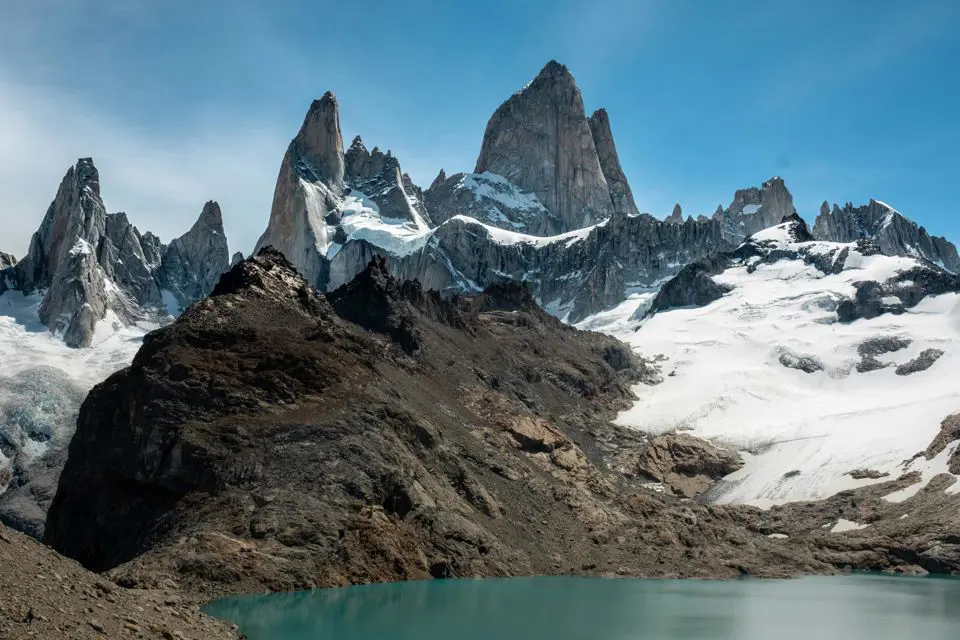
Torres del Paine National Park is one of the most important natural treasures of southern Chile, and one of the essential destinations for every traveler visiting that region. However, if you are getting to know the Argentine side of Patagonia, you don't have to worry: you can simply access this landscape by crossing a border point that is very close to El Calafate, the Argentine city nearest to the national reserve that bears its name. The best and easiest way to do it is joining our day trip to Torres del Paine from El Calafate.
Anyway, in this article, we want to advise you so you can see this beautiful point on the Latin American map with your own eyes without complications.
Where is Torres del Paine Located?
Torres del Paine National Park is located in southern Chile, within the Magallanes and Chilean Antarctica Region, approximately 150 kilometers north of Puerto Natales and about 250 kilometers from Punta Arenas. It forms part of Chilean Patagonia, one of the southernmost and most spectacular areas of the continent, characterized by its mountainous relief, glaciers, turquoise water lakes, and extensive steppes.
From Argentina, the most common access is through the city of El Calafate, in the province of Santa Cruz, from where you can cross the border via the Cancha Carrera – Cerro Castillo pass (popularly known as Río Don Guillermo Border Crossing). The park is located within the Cordillera del Paine, an independent massif of the Andes, famous for its granite rock formations that rise abruptly above the surrounding valleys and lakes.
How to Get to Torres del Paine from El Calafate
Getting to Torres del Paine National Park from the Argentine city of El Calafate is very simple. You can do it on your own, in your personal or rental vehicle, or, for those who do not drive or do not have that possibility, through private transfers and guided excursions of one or several days.
Between the Santa Cruz city of El Calafate—which, it is worth noting, has its own airport—to Torres del Paine National Park, in the Magallanes Region, there is a distance of 257 kilometers. In case you travel on your own, we tell you how to do it.
From El Calafate, you have to take Provincial Route No. 11, connect southwest with National Route No. 40, and traverse the Patagonian steppe. It is recommended to follow this route to the locality of Esperanza, as the detour via Provincial Route No. 7 might not be in the best conditions. Then, continue along the same road to the Río Don Guillermo International Border Crossing.
Looking at the map, you will notice that the route takes a big turn despite the short distance between the city and the Chilean natural reserve: it happens that, due to geographical issues of the region, the routes extend a few kilometers further through the steppe, delaying the trip by about 3 or 4 hours, depending on the speed and type of vehicle you are traveling in.
After crossing the international pass, once in Chile, continue to the entrance of Torres del Paine National Park, via the route to the access point (for example, from the "Laguna Amarga" or "Portería Sarmiento" entrance). Before that, we suggest stopping to rest and recharge energies at the cafeteria located a few meters from the immigration control post. It is a classic stop for travelers to eat a delicious torta frita with mate cocido and many other delights.
Anyway, another easy and comfortable way to get to Torres del Paine from El Calafate is with private tours and excursions that, in addition to round-trip transfers, include the accompaniment of professional guides who will relate during the whole trip the necessary details about the geography and history of this spectacular destination.
From Argentina to Chile: Requirements to Cross the Border
To cross from Argentina to Chile through a migration pass, Argentine residents must mandatorily present a digital DNI (card or light blue booklet) or valid passport. Old documents, proof of paperwork in progress, or deteriorated documents are not accepted.
In the case of foreign residents, entry to Chile is made with the passport of the country of origin and, if applicable, with a valid Chilean visa. Those who are citizens of Mercosur or countries with free transit agreements can enter only with their valid national identity document, without the need for a visa.
If minors under 18 are traveling, in addition to the valid document, they must comply with authorization requirements:
Authorizations must be processed personally and in-person at migration offices or crossings. In urgent situations, a single-trip permit valid for 30 days can be managed.
Why is it Called Torres del Paine?
The park's name comes from its three most emblematic peaks: the Torres del Paine, three granite needles modeled by glacial erosion millions of years ago. These towers—called Torre Sur, Torre Central, and Torre Norte—reach heights close to 2,500 meters above sea level and are the park's most recognizable symbol.
The word "Paine" comes from the Tehuelche or Aonikenk language, one of the native peoples of Patagonia, and means "blue," alluding to the color dominating the landscape: that of the glaciers, lakes, and Patagonian skies. Thus, "Torres del Paine" literally translates as "Blue Towers," a name synthesizing the visual essence of the place: imposing mountains rising above an environment of ice, waters, and deep blue skies.
Why Visit Torres del Paine?
We can mention the majestic glaciers, the imposing granite towers, and the deep blue lakes awaiting in this National Park which was declared a Biosphere Reserve by UNESCO and the Eighth Wonder of the World.
The enormous amount of native animals embellishes the visiting experience: red foxes, ñandúes (rheas), guanacos, condors, black-faced ibises (bandurrias), pumas, and much more. The millenary trees and vegetative species resisting so gracefully the windy, cool, and dry climate also stand out in the landscape.
However, despite this description, sometimes images say much more than words: just by seeing a photo or video of this wonderful destination in southern Chile, one perfectly understands why it is one of the top choices for tourism in Patagonia.
But beyond the contrasting and spectacular landscapes, Torres del Paine National Park is attractive for tourism because it has a great structure to summon hundreds of visitors a year without corrupting the ecosystem.
Accommodations, gastronomic services, excursions, and adventure activities are designed by professionals to guarantee a comfortable, safe, and pleasant experience, without damaging the flora and fauna.
In addition, famous trekking circuits like the "W" and the "O" make this site tempting for any solitary traveler or group of friends wanting to breathe fresh air, walk, or contemplate different classic scenarios of Patagonia.
When Can Torres del Paine Be Visited?
All year round. But, obviously, winter is the rawest and most hostile season to do so (in the southern hemisphere it implies the months of June, July, August, and mid-September). The advantage is that prices are lower, and there are more possibilities to spend the night in one of the multiple accommodations. Between December and February, the largest number of tourists is concentrated because days are longer, the climate is more pleasant, and most trails are enabled.
Should I Bring Cash to Torres del Paine?
The Tourism Secretariat suggests visitors bring as much cash as they can since within the National Park there are no ATMs and very little mobile phone signal or Wi-Fi, so you won't be able to buy items or pay for services with that methodology.
Where to Stay in Torres del Paine
Sleeping in front of Patagonia's most iconic mountains is an experience worth planning in advance. In Torres del Paine National Park, there are options for all traveler profiles: from luxury hotels with privileged views to campsites nestled between lakes and glaciers. In the most exclusive cases, advance reservation is indispensable, especially during high season.
The important thing to know is that each visitor has to reserve campsites or shelters in advance, since camping outside enabled zones is not allowed.
The Chilean Tourism Secretariat recommends opting for accommodations registered in Sernatur, the body guaranteeing quality and tourist sustainability standards.
There is an economic modality, staying only in the free campsites provided by CONAF, the park administrator. The free campsites of the W Circuit are Campamento Torres, Campamento Italiano, and Campamento Paso.
Then there is an intermediate modality which is sleeping in the private campsites of the companies Fantástico Sur and Vertice Patagonia, distributed on the most famous trekking routes, such as the W or O circuit. The most luxurious way is staying in the shelters (refugios) of the same companies in shared rooms with full board. Some services offer full board: breakfast, packed lunch for the route, and dinner. At the time of booking, this option will appear as "full" or "complete." This is interesting so you can hike light, without needing to carry camping equipment.
Another alternative is to travel "deluxe" and stay in complexes recommended by CONAF: for example, Reserva Las Torres Patagonia, located at the foot of the mountains. Renting fully equipped tents in Torres del Paine can cost from CLP $101,000 per person in high season. Then there is Tierra Patagonia, with architecture integrated into the landscape and spa services; and Explora Lodge Torres del Paine, one of the most recognized for its sustainable luxury proposal.
For those seeking a more immersive experience, Ecocamp Patagonia offers geodesic domes inspired by the dwellings of native peoples, while Patagonia Camp combines ecological design and comfort next to Lago Toro. Hotel Lago Grey also stands out, with excursions to the homonymous glacier, and Hotel Río Serrano, ideal for those preferring a comfortable starting point to tour the different sectors of the park.
Those looking for a more local experience, there are Patagonian estancias in the surroundings of the park, where it is possible to stay and share rural life, with horseback riding, typical food dishes, and the warmth of the hosts.
In any of these modalities, the advice is the same: plan ahead and book online through official sites or social networks of each accommodation. Demand is high and, once inside the park, distances between one point and another can be long.
What are the Circuits of Torres del Paine?
In Torres del Paine National Park, there are trekking circuits for all levels of experience. The most emblematic is the W Circuit, ideal for those looking for a demanding but accessible hike: it tours the park's most famous valleys and viewpoints in 4 to 6 days, with days of around 8 hours daily.
For adventurers with more experience, the maximum challenge is the O Circuit, a complete route of more than 100 kilometers circling the entire Paine massif and demanding between 6 and 8 days of marching, with rocky sections, steep slopes, and little-traveled mountain landscapes.
In addition, the park offers shorter and accessible trails, which can be done in one or a few hours. Among them, the trail to Base Torres stands out, an eight-hour round trip hike leading to the most famous viewpoint; the Ferrier, Cóndor, and Cuernos viewpoints, with panoramic views of lakes and peaks; and the path to Laguna Cebolla, located before the park entrance and with free access.
In any of its versions, the Paine circuits are an invitation to live Patagonia in motion, among glaciers, rivers, and mountains changing color with daylight.
Published by Has Chacon on 08/06/2026