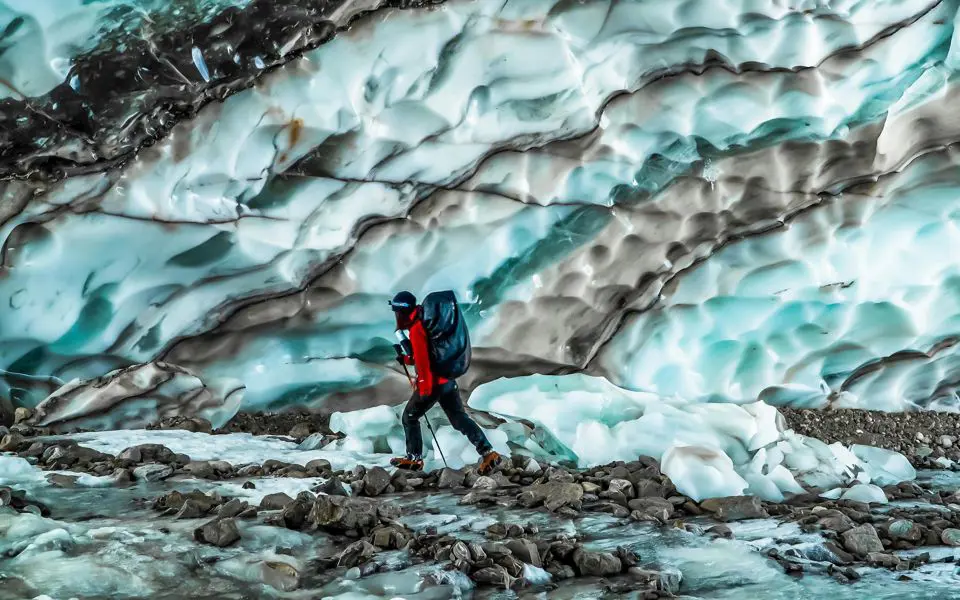
Encountering the Perito Moreno Glacier in El Calafate is an image that remains etched in memory forever: azure, towering, cold, and vast. Beyond the enormous ecological benefits it provides to the Earth, this giant block of ice is a true treasure for Argentines and their visitors. Now, imagine if, besides seeing it, you had the opportunity to touch it?
This emblem located in the heart of Los Glaciares National Park, in the province of Santa Cruz, is one of Argentina's most popular destinations for vacations and getaways in any season. Over time, proposals to see it in detail and learn about its characteristics have become more sophisticated thanks to tourism, and among several activities put into practice, one stands out: ice trekking.
This time we are going to talk about the two most special excursions to live this adventure: the Minitrekking on the Perito Moreno Glacier, for adventurous but cautious souls, and the Big Ice trekking, for those who enjoy a shock of adrenaline. Both are organized by Hielo y Aventura, the only professional company authorized to carry out these journeys, with limited quotas and specialized guides.
The idea tempted you, didn't it? Now, which one is better to do? What are the differences between Big Ice and Minitrekking? We tell you the details so you can choose the ideal experience according to your traveler profile.
Minitrekking on the Perito Moreno Glacier
The Minitrekking on the Perito Moreno glacier is the perfect option for those looking for an accessible, safe, and exciting adventure. It is a walk of low to moderate difficulty, designed for a wide age range (from 10 to 65 years old) and with a total duration of about eight hours, including transfers, navigation, and a tour of the park's walkways (boardwalks).
The excursion begins with the pick-up at the hotels in El Calafate very early in the morning heading to Los Glaciares National Park. From the Puerto Bajo de las Sombras, a short navigation is made through the Rico Arm of Lago Argentino until reaching the starting point of the hike. From the water, the Perito Moreno glacier already looks imposing. Those fortunate enough to hear the ice calving are left speechless.
Now, after disembarking, the guides hand out crampons and briefly explain how to move on the ice. From there begins the true adventure: a walk on the Perito Moreno glacier of approximately two hours, discovering caves, crevasses, pools of blue water, and frozen formations that seem to be from another planet.
The experience closes with a special toast "on the rocks," with ice from the glacier itself, and some free time to walk the panoramic walkways of the park. Undoubtedly, the Minitrekking on the Perito Moreno Glacier is an unforgettable experience for those visiting El Calafate for the first time.
Big Ice: The Most Intense Adventure on Perito Moreno
The Big Ice Perito Moreno Glacier is designed for those looking to go further and live a complete glacier trekking experience. It is a high-difficulty hike, of about four hours on the ice, which allows you to go deep into the less-traveled areas of the glacier and discover its wildest landscapes.
The tour begins in the same way as the Minitrekking, with a transfer from El Calafate and a boat trip across Lago Argentino to the exclusive access point. Then, the guides hand out the necessary equipment and give a technical talk on the use of crampons and safety.
From there, the walk on the ice begins. Participants traverse deep crevasses, frozen tunnels, intense blue lagoons, and unique formations while the guides explain the glacier's processes, the typical animals and vegetation of the region, and other important facts.
Halfway through, a pause is made for lunch (each traveler carries their own box lunch), surrounded by a white and blue landscape. Upon returning by the same path, the tour concludes with a walk on the boardwalks, offering spectacular views of the glacier's front wall.
Big Ice or Minitrekking?
The choice between these two alternatives depends on several factors:
On one hand, physical fitness, since not everyone may be suitable for the Big Ice experience, while the Minitrekking usually demands less and is accessible to the majority. regarding the duration and intensity of the excursion, we can consider that Big Ice is more intense and longer, but the other is no less exciting. Even so, we know that budget is one of the main conditioning factors: Big Ice usually has a higher price, greater logistical demand, and lower availability of spots. Furthermore, we can guarantee that both options are designed with rigorous safety and environmental responsibility standards, aiming for the experience to leave a positive—never invasive—mark on the landscape.
So, whatever your chosen option, you will have an excellent time, engage in an eco-friendly activity, and take home incredible memories and stories.
Perito Moreno Glacier: History and New Adventures
Keep in mind: the Perito Moreno Glacier is named after the Argentine explorer Francisco Pascasio Moreno, the expert (perito) in charge of delimiting the territory of Patagonia and who defended the forests and glaciers as national heritage at the end of the 19th century.
Another significant and exciting fact is that the glacier is part of the Southern Patagonian Ice Field, one of the largest freshwater reserves in the world.
Since 1981, Los Glaciares National Park has been a UNESCO World Heritage Site, and every year receives thousands of visitors interested in exploring its glaciers, lakes, and mountains.
A very recent piece of information adds a precious twist to that search for new ways to approach the glacier: Los Glaciares National Park launched a pilot test of night visits to the boardwalk circuit during the full moon, scheduled for November 3 to 7, 2025.
In this initiative, authorized companies will be able to conduct tours between 8:00 PM and midnight, with small groups, prior request for permits, and permanent accompaniment of guides. The goal is to evaluate how the logistics, environmental impact, and the experience of seeing the ice under the moonlight work.
If that pilot prospers, night tourism would allow discovering the glacier from another dimension, adding surprising sensory value.
Published by Has Chacon on 08/06/2026